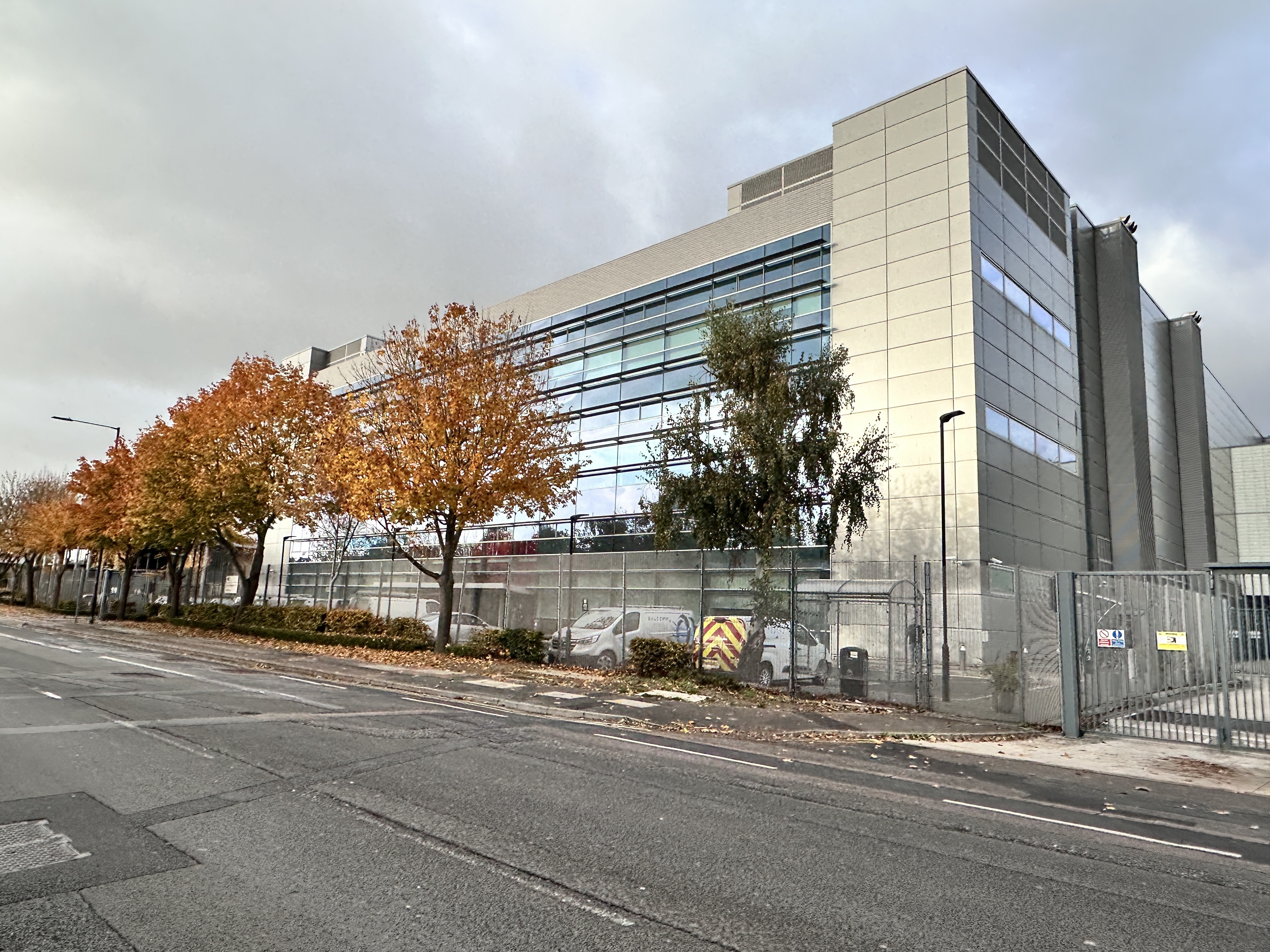
What the growth of Slough’s data-centre industry means for local residents. Updated 2 November 2026.
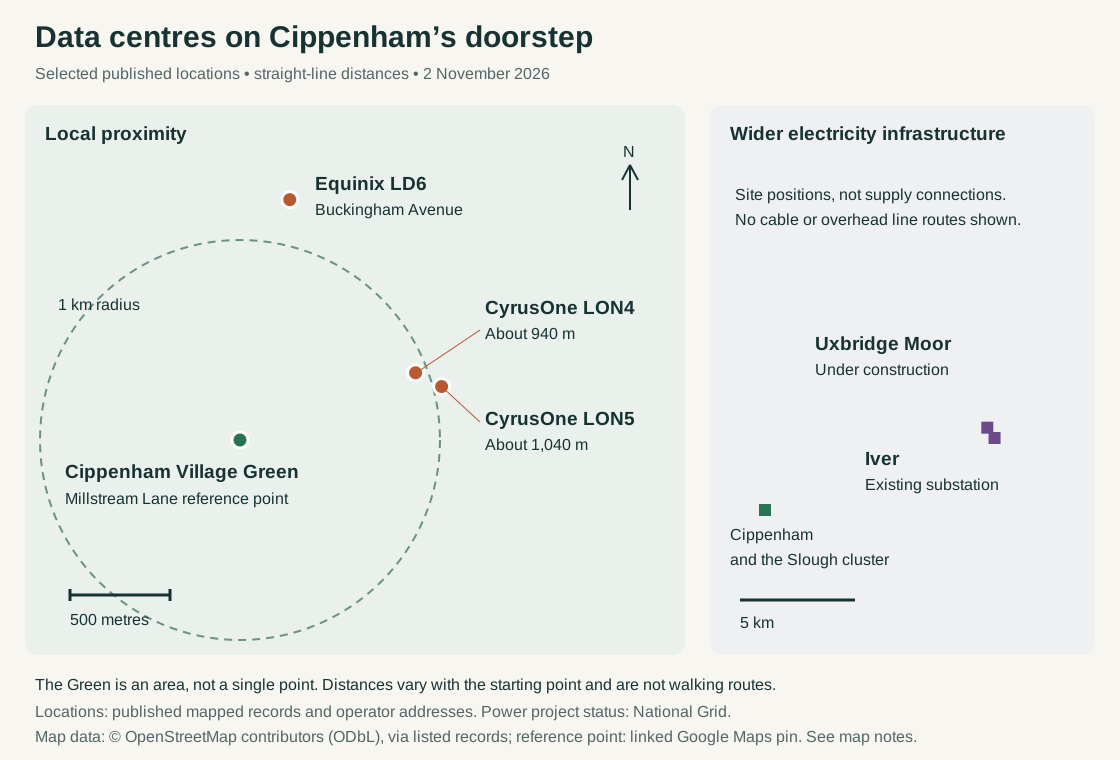
The data-centre boom begins within a kilometre of Cippenham Village Green. CyrusOne’s LON4 building on Bath Road is about 940 metres in a straight line from the Green’s Millstream Lane side. Its neighbouring LON5 building is about 1.04 kilometres from that same reference point. The distance changes with where you stand on the Green; these are not walking distances. [1],[2],[3]
For Cippenham, the expansion raises practical questions. Will cooling equipment be audible at night? Who pays for electricity infrastructure? How much water is used? Can the investment improve the place where we live?
This article was prompted by residents’ questions and the linked YouTube Short credited to Led By Donkeys. We acknowledge that contribution to the discussion. The film is linked below as campaigning material; the factual account here rests on the separately identified sources. [4]
Why the industry is here
Slough combines industrial land close to London with established communications networks and a long history of supplying electricity to industry. Once operators and their customers cluster together, connections between them give others a reason to follow.
Planning has also encouraged development. The Trading Estate’s Simplified Planning Zone, adopted in November 2024 for 2024–34, grants permission in advance for qualifying development subject to its conditions. It does not give every proposal unrestricted approval or remove environmental controls. [5]
SEGRO describes the estate as Europe’s largest data-centre hub. That is the landlord’s description, rather than a ranking established here using a common definition of a data centre. Its March 2026 announcement of another powered-shell development shows that expansion is continuing. [6]
The facilities serve cloud services, businesses and communications as well as the growing market for AI. It would be misleading to describe every existing Slough building as an AI data centre.
Electricity and the works needed to deliver it
A data centre’s power requirement includes both its computers and the equipment keeping them running. Published IT capacity is not the same as the whole building’s electricity demand, and maximum capacity is not a measurement of continuous consumption.
CyrusOne’s LON4 datasheet specifies 18 megawatts of IT load. As an illustration, 18MW running continuously for a year would consume about 158 gigawatt-hours before cooling and other building overheads. That calculation describes a scenario, not LON4’s actual annual consumption. [2]
The wider network is being enlarged. National Grid is building Uxbridge Moor substation beside its existing Iver site, with construction expected to continue through 2029. A substation switches electricity and changes voltage; it does not generate power. National Grid says the project responds to requests for new connections in the area. [7]
For households, that means looking beyond the server buildings to substations, cable works, construction traffic and the coordination of road closures. The accompanying map locates the major sites but does not invent cable routes or imply that Uxbridge Moor directly supplies the particular buildings shown.
The evidence does not establish that Cippenham households face imminent power cuts because of data centres. It does justify asking network companies and developers to explain the capacity being requested, the works required and how disruption will be managed.
Noise after dark
Fans, chillers, pumps and electrical equipment can operate throughout the night. A steady hum can be intrusive when traffic has subsided, even if it seems unremarkable during the day.
The Environment Agency’s guidance recognises that the character of industrial sound matters, including audible tones. A single average noise figure cannot describe every disturbance. [8]
Local investigation needs to establish the source, the weather and operating conditions, and the combined contribution of nearby sites. A complaint alone cannot identify the responsible operator, while a prediction made before construction cannot settle what residents experience afterwards.
Independent monitoring near homes, including overnight measurements, would give residents and operators a firmer basis for resolving complaints. Residents reporting a problem can help by recording dates, times, duration and where the sound is audible.
Generators and air quality
Computers do not burn fuel to process information, but many data centres maintain diesel generators for interruptions to grid supplies. Testing and emergency running produce exhaust emissions.
Environment Agency guidance requires operators covered by its installation rules to manage air-quality impacts and assess appropriate controls. In a cluster, the possibility of several sites operating during the same power failure deserves attention, alongside routine testing. [9]
The presence of generators is not evidence that they run continuously. Equally, describing them as emergency equipment does not remove the need to examine emissions during a prolonged outage. Useful public information would include operating hours, fuel and emissions controls, testing arrangements and the assumptions used in assessments of simultaneous operation.
Electricity generation elsewhere also carries an environmental cost. A renewable electricity purchasing claim should be read with its methodology: it does not, on its own, demonstrate that a building is supplied by carbon-free generation every hour.
Water depends on the cooling system
Some cooling systems evaporate water to remove heat. Others circulate fluid in a closed loop and reject heat through air-cooled equipment. Water circulating inside a system is not the same as water consumed and replaced.
CyrusOne describes LON5 as using closed-loop water cooling. That is relevant local information, but it is not an independently audited water-consumption total, nor proof that every stage of cooling at every nearby site uses no water. [10]
An abstraction licence states what may be taken under its terms; it does not show what was actually used. Comparisons should distinguish drinking water, groundwater, reclaimed water and any seasonal demand.
Residents need annual consumption and peak-day use for each substantial facility, with the source and cooling method stated. The Commons Library identifies both the variation between technologies and concerns about transparency. [11]
Where the heat goes
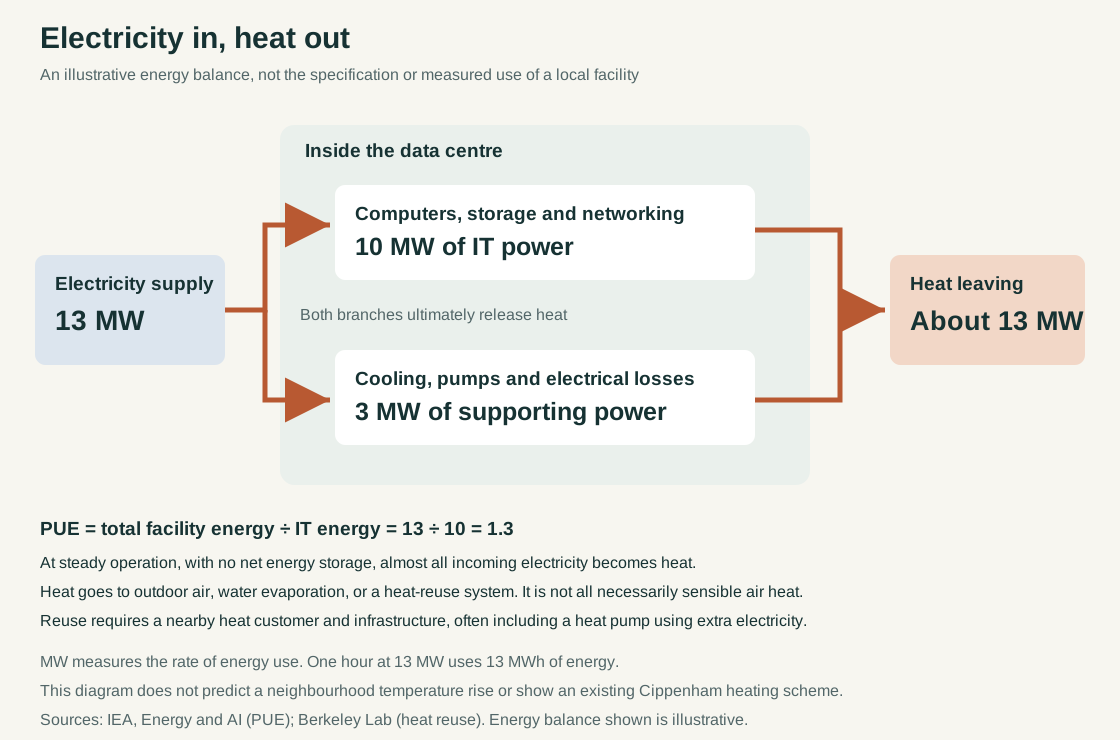
Almost all the electricity consumed by computers and their supporting equipment ultimately becomes heat. Cooling moves that heat out of the building. It does not make the energy disappear.
The diagram uses an illustrative facility taking 13MW from the grid: 10MW powers the IT equipment and 3MW supplies cooling, electrical losses and other services. Its power usage effectiveness, or PUE, is 1.3. Over steady operation, approximately 13MW must leave as heat unless some energy is stored or exported in another form. This is an explanation of the energy balance, not a measurement of a Slough site. [12]
Heat output does not translate directly into a temperature rise at a particular home. Wind, building layout, exhaust height, vegetation and hard surfaces all affect what happens nearby. Satellite measurements of land-surface temperature are also different from the air temperature people experience.
At a parliamentary hearing on 1 July 2026, an industry witness said a survey of the Slough area’s combined heat impact had not been undertaken and welcomed an evaluation. That supports the case for local research; temperature figures raised in a committee question should not be treated as established measurements. [13]
Heat could sometimes be recovered for nearby buildings. Research from Lawrence Berkeley National Laboratory explains why warmer cooling circuits can make reuse more practical. A working scheme still needs a suitable customer, pipes, investment and often a heat pump. Cheap heating for Cippenham would require a specific funded project. [14]
Jobs and benefits for residents
Construction brings work, and operating facilities require engineers, technicians, maintenance and security staff. These are often substantial buildings with relatively modest permanent workforces. Construction employment, permanent on-site jobs and wider supply-chain estimates should be reported separately. [11]
For Cippenham, paid apprenticeships, training partnerships and published local recruitment results would make the employment benefits easier to judge. Business rates and planning contributions also need to be distinguished from additional voluntary investment in local amenities.
The Government’s Data Centre Covenant, published on 28 October, sets out expectations for operators and additional tests for strategic projects seeking government support. It calls for local benefit plans tied to development size, environmental reporting, skills and jobs, and heat reuse where viable. [15]
This creates an opening for residents to seek investment in parks, transport, community facilities or training. It should not be presented as a guaranteed payment to each nearby household. Any local agreement needs a stated amount, delivery timetable and accountability, with residents involved in deciding priorities.
SEGRO’s agreed takeover
SEGRO has agreed to be acquired by Prologis. Its latest trading update says shareholders approved the scheme on 28 September and completion is expected in the first half of 2027, subject to remaining conditions. The deal has not yet completed. [16]
The Competition and Markets Authority opened an invitation for comments on 27 October, closing on 10 November. As at 2 November, its case page says the formal investigation has not yet launched. The consultation concerns competition effects, rather than replacing local planning or environmental procedures. [17]
New ownership could influence the estate’s investment priorities. Prologis identifies digital infrastructure among the combined business’s growth opportunities. That is a reason to follow its plans, not evidence that a particular additional development has been approved. [18]
Community commitments should therefore have clear responsibilities and arrangements for delivery through ownership changes. Residents should be able to see who is accountable for each promise.
Security and the concentration of infrastructure
The Government designated data centres as Critical National Infrastructure in September 2024, recognising how much essential activity depends on them. [19]
Cyberattack, sabotage, fire and power failure are relevant to resilience planning. Concentrating facilities in one area makes common disruptions an issue worth examining. The designation does not establish that Cippenham faces an elevated likelihood of attack, and no quantified local risk assessment is offered here.
Residents can reasonably expect emergency coordination and useful public information about potential disruption. Security precautions do not remove operators’ responsibility to explain environmental impacts.
What Cippenham should ask for
The useful next step is a public account of the cluster’s combined effects. That should bring together noise measurements, local temperature monitoring, water and electricity reporting, generator assessments and a coordinated programme of infrastructure works.
The benefits need the same scrutiny: how many lasting jobs, which training places, what community investment and when it will arrive. Cippenham is close enough to these developments to deserve specific answers, with evidence that residents can examine.
Recent press articles
- The Guardian, 26 June 2026: ‘Slough is like an experiment’: Europe’s largest datacentre hub leaves town sweltering.
- Financial Times: Slough has become the data centre capital of Europe. Now it wants its reward. A subscription may be required.
References
Links checked or attempted on 2 November 2026. Operator statements are identified as such.
- Slough Borough Council: Cippenham Village Green. Map reference point, sources and calculation method.
- CyrusOne: LON4 datasheet, operator specification and Bath Road address.
- CyrusOne: LON5 datasheet, Site C, 225 Bath Road. Building coordinates from mapped records are listed in the map data file.
- Led By Donkeys: YouTube Short supplied for this article. Attribution supplied by the commissioning editor; no quotation or factual claim is drawn from the film.
- Slough Borough Council: adopted Simplified Planning Zone 2024–2034.
- SEGRO: Data Centre Update, 16 March 2026.
- National Grid: Uxbridge Moor substation, including the linked project map.
- Environment Agency: method implementation document for BS 4142.
- Environment Agency: emergency backup diesel engines, best available techniques.
- CyrusOne: London LON5, operator description of cooling.
- House of Commons Library: Data centres, planning policy, sustainability and resilience, 27 May 2026.
- International Energy Agency: Energy and AI, PUE definition and energy accounting. Diagram arithmetic is illustrative.
- House of Commons Environmental Audit Committee: oral evidence, 1 July 2026, questions 99–101.
- Lawrence Berkeley National Laboratory: Avoiding Waste Heat through AI Infrastructure Thermal Integration.
- HM Treasury: The Data Centre Covenant, 28 October 2026.
- SEGRO: Q3 trading update, period to 30 September 2026.
- CMA: Prologis / SEGRO merger inquiry.
- Prologis: recommended acquisition announcement.
- Government statement: Designating UK Data Infrastructure as Critical National Infrastructure, 12 September 2024.


Comments (0)